From Paris to Chinatown: Christophe Gaillard Takes a Floor of the Bangkok Kunsthalle
Ahead of the March 2027 opening of his gallery’s new space in the same building as the Bangkok Kunsthalle, Christophe Gaillard discusses why he chose Bangkok, sharing a building with an institution, preserving the rawness of a former printing house, and building a lasting presence in Asia beyond the art fair calendar.
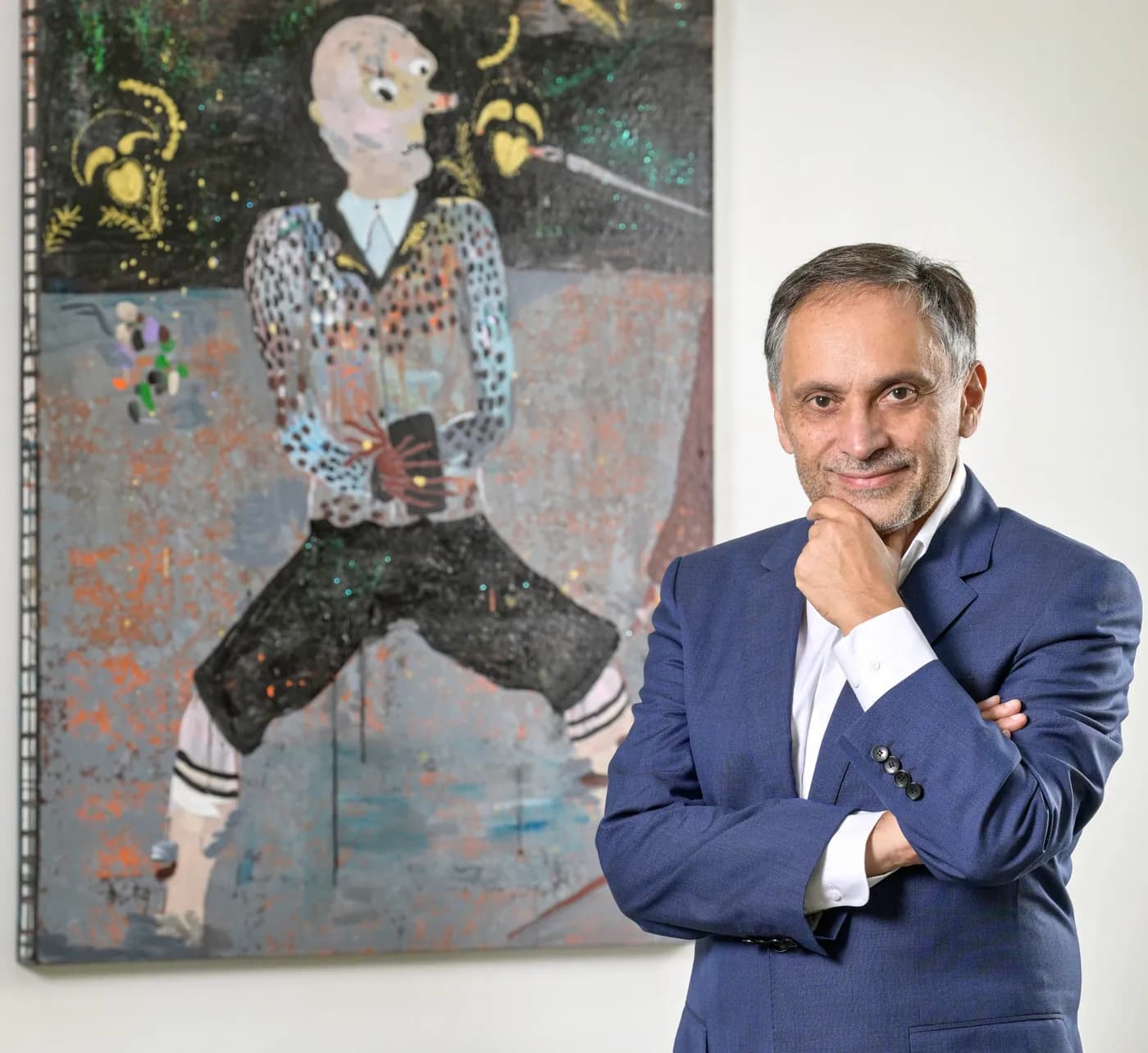
Christophe Gaillard. Credits: Julio Piatti
In March 2027, Galerie Christophe Gaillard will open a new space within the same building as the Bangkok Kunsthalle, occupying an entire floor of around 300 square meters in the former printing house in Chinatown. The Bangkok space, which will operate independently of the Kunsthalle’s own program, will open with a group exhibition bringing together gallery artists, including Hélène Delprat and Richard Nonas, alongside artists from various Asian art scenes.
I spoke with the gallery’s founder, Christophe Gaillard, about why he chose Bangkok over the region’s established art hubs, the relationship with the Kunsthalle, the raw architecture of the building, the artists of the region and the place of art fairs in the gallery’s future.
Q: You say that “at a time when everyone is seeking to be cautious, it seemed reasonable for us to be unreasonable.” Bangkok is hardly an obvious choice for a European gallery, not least in bureaucratic and fiscal terms. It also comes after Brussels and L’Usine, on the eve of your twentieth anniversary. Why Bangkok, and why now?
The choice of Bangkok was born, first of all, from an encounter. Or rather, from several encounters: with an extraordinary place, a former six-story printing house that is now home to the Bangkok Kunsthalle, and with Marisa Chearavanont, its patron, and Stefano Rabolli Pansera, its artistic director.
We had studied several possibilities for establishing ourselves in Asia. Bangkok was not necessarily our most obvious choice. But sometimes a place, people and a particular moment suddenly make possible what, until then, had been only a hypothesis.
What also struck me was the transformation of Bangkok’s art landscape. With the Bangkok Kunsthalle, Dib Bangkok and soon MONA, we are witnessing the emergence of three institutions that reflect a new cultural ambition. These initiatives are not simply additional venues: they are helping to form a true ecosystem, one capable of bringing artists, collectors, curators and international institutions into dialogue.
Why now? Perhaps precisely because we are about to celebrate the gallery’s twentieth anniversary. After Paris, Brussels and L’Usine, we might have decided it was time to consolidate what we had built. But I believe a gallery must keep putting itself at risk, shifting its habits, questioning its own model.
When I said that it seemed reasonable for us to be unreasonable, it was not just a turn of phrase. I wanted to express this conviction: at a time when the art world tends to favor caution and retreat, one must sometimes accept a measure of risk in order to keep inventing.
Q: In recent years you have built a network of collectors and institutions in China. Why not open there, or in Hong Kong or Singapore, which are the established art market hubs in the region? And who are the collectors in Thailand and Southeast Asia today?
Precisely because these cities are already established hubs. Hong Kong, Singapore and several major Chinese cities have structured markets, powerful international networks and a significant presence of foreign galleries. They are fascinating cities, where we will naturally continue to work. That is also why, at the beginning of this year, we welcomed a new colleague, Yilin Chen, who serves as the gallery’s China Director and with whom we are already developing an ambitious program of exhibitions and fairs.
But Bangkok offered us something else: the chance to take part in a movement still in the making, rather than settling into a system that is already largely established.
Thailand has a rich art history, a particularly vibrant contemporary scene and collectors, some of whom have long shown a remarkable commitment to artists. It would be reductive to regard the country as an emerging market simply because its international visibility is still relatively recent.
Bangkok should also be seen on a broader geographical scale. The city occupies a particularly interesting geographical and cultural position, at the crossroads of Southeast Asia’s art scenes — Singapore, Vietnam, Cambodia, Indonesia and the other countries of the region — but also in relation to more distant territories such as India and the United Arab Emirates.
As for collectors, I am always wary of the idea that simply opening a gallery somewhere is enough to immediately discover a new market. Relationships with collectors are built over time, through trust, curiosity and the quality of the artistic proposals.
Our ambition, then, is not to transplant a European commercial model to Bangkok, but to gradually develop a network of relationships with its own coherence, while remaining connected to Paris, Brussels, Hong Kong and mainland China.
Q: The gallery will occupy a floor of the Bangkok Kunsthalle. How did the collaboration with Marisa Chearavanont and Stefano Rabolli Pansera come about?
It grew out of a convergence of sensibilities and a shared desire to bring demanding artistic projects to life.
I was immediately drawn to what Marisa Chearavanont has made possible with the Bangkok Kunsthalle: a place of great freedom, whose ambition is not to reproduce Western institutional models, but to offer a singular artistic experience, deeply tied to the architecture and history of the building.
My conversations with Stefano Rabolli Pansera were also decisive. We share, I believe, a certain idea of contemporary art: an art that should not be reduced to its market dimension, that can take risks, occupy unexpected spaces and produce experiences that go beyond the mere presentation of objects.
At the outset, we were not looking for a commercial space within a cultural building. It was the encounter with this project, and with the people behind it, that led us to imagine the possibility of setting up a gallery there.
What I particularly like is that this proximity does not rest on any blurring of roles. The Kunsthalle pursues its own institutional and artistic project; the gallery develops its own. But this coexistence can create circulation, conversations and, I hope, opportunities for unexpected encounters.
Q: The gallery will operate independently of the Kunsthalle, yet the project grew out of an encounter and a shared ambition. Where do you draw the line? I’m thinking of Richard Nonas, who has already been shown at the Kunsthalle and will feature in the group show inaugurating your space.
The line is very clear in terms of responsibilities, but there is no reason for it to become an intellectual boundary.
An institution and a gallery have neither the same function nor the same obligations. The Kunsthalle develops its own program, while we fully embrace our role as a gallery, with everything that entails: supporting artists, championing their work, building their visibility and contributing to the circulation of their works.
But I do not believe in the idea that the institutional world and the market should live in sealed-off universes. On the contrary, art history shows how often galleries have been places of experimentation, production and discovery, well beyond their commercial function.
Richard Nonas is an interesting example. His work has an extremely strong relationship to space, to architecture, to the way a body physically experiences a place. The fact that he was shown at the Kunsthalle and is included in our inaugural exhibition does not reflect any confusion between the two structures. Rather, it reveals a shared sensibility toward a body of work that has a particular power in an environment like this one.
I am committed to the gallery retaining its full artistic and commercial independence. But that independence excludes neither dialogue nor affinity.
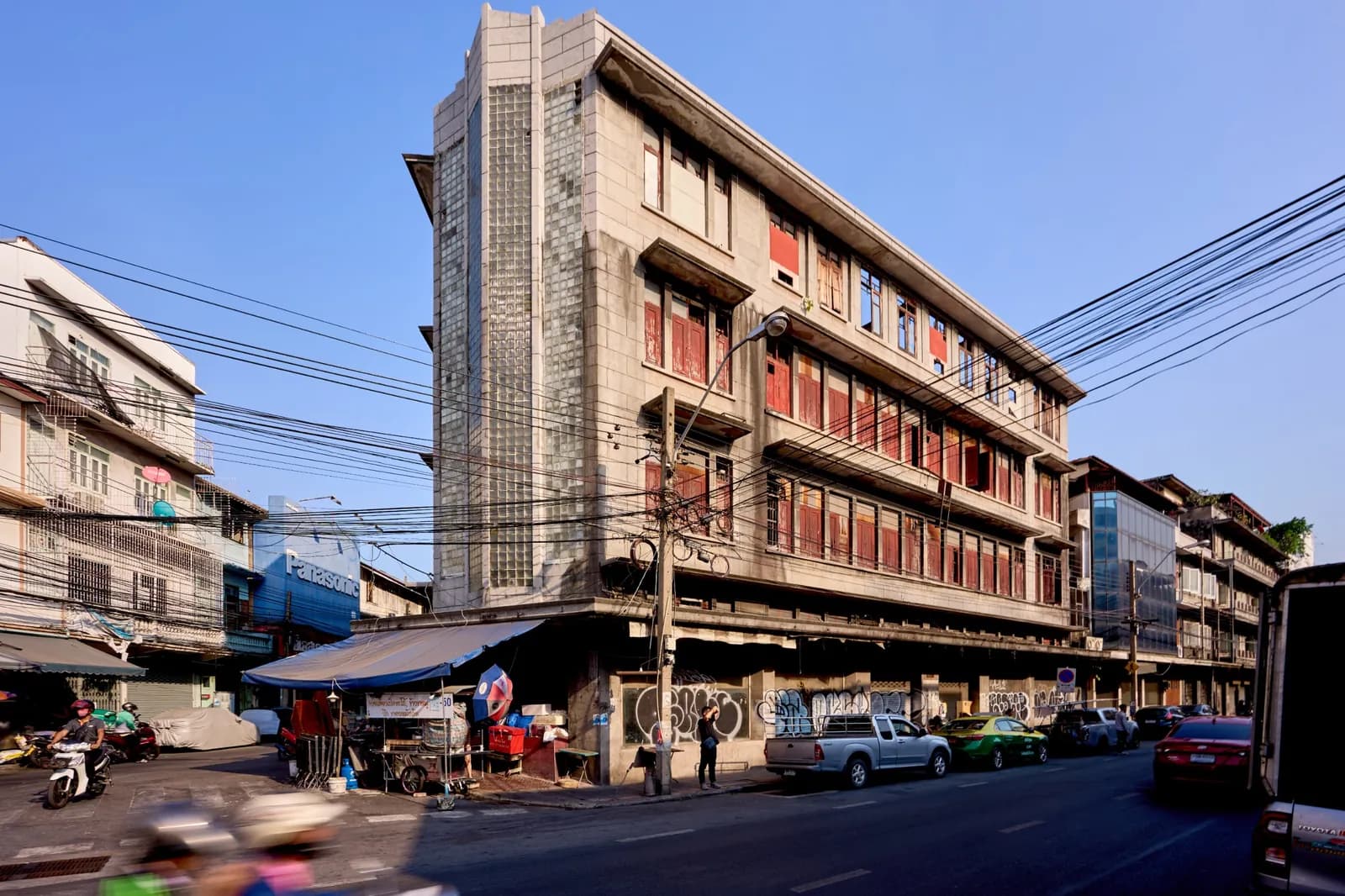
Bangkok Kunsthalle, Chinatown, Bangkok
Q: At the Kunsthalle, each exhibition opens up a new part of the building, a former brutalist industrial complex with a strong rawness. How does the gallery fit into this context? Will you keep the space as it is, with its rawness, or turn it into a white cube?
I have no desire to erase what makes this building unique.
In my view, it would even be a mistake to come to Bangkok, choose such an exceptional place, and then try to turn it into an interchangeable gallery, like those one might find in Paris, London or New York.
We want to preserve the industrial memory of the place, its materiality, its rough edges, while creating the conditions needed for a rigorous presentation of the works.
There will therefore be a kind of dialogue between two languages: that of the existing architecture, with its raw quality, and that of a more controlled exhibition space, particularly in terms of lighting, circulation and display.
I like the idea that a gallery is not merely a neutral container, but has a personality, a physical presence, and that artists can take hold of it.
The white cube has its qualities, but it is not a universal truth. Some works need neutrality; others, on the contrary, benefit from encountering an architecture that pushes back a little.
Our space in Bangkok must be able to accommodate both possibilities.
Q: Your opening group show will bring together gallery artists and artists from various Asian art scenes. How did you select them? More broadly, you speak of long-term relationships with artists and cultural figures in the region. Does this mean representing Thai or Southeast Asian artists, and bringing them to Paris and Brussels as well?
Above all, the first exhibition must affirm an artistic identity. It cannot be reduced to a presentation of our roster, any more than to a selection of Asian artists brought together simply because of their geographical origin.
What interests me are the connections, the tensions, the sometimes unexpected correspondences between artistic practices that have developed in different cultural and historical contexts.
Since its founding, the gallery has been built around strong artistic personalities, often singular, sometimes hard to classify, and not necessarily aligned with the dominant currents of their time.
It is this same curiosity that I want to bring to Bangkok.
I do not want to arrive with a European reading of the Thai or Southeast Asian art scene. One must take the time to look, to meet, to listen, to understand local histories and the issues specific to each scene.
Representing artists from the region is naturally part of our plans. But I want these collaborations to grow out of genuine encounters and artistic conviction, not from a strategy of artificially adding a few Asian names to our program. That said, we already know that a Thai artist, a Korean artist and a Chinese artist will be joining the gallery very soon.
One of the most stimulating aspects of this new venture will be precisely to allow circulation in both directions: presenting our European artists to new audiences, but also helping to bring to Europe artists whose work seems essential to us.
Q: You take part in fairs such as Art Basel, Art Basel Hong Kong and Frieze Masters, but the fair model is increasingly being questioned, and some call it unsustainable. Does a physical space in Asia change your relationship with fairs, or partly replace them?
Fairs have become almost indispensable tools for galleries, but their proliferation raises real economic and artistic questions.
They make it possible to meet a large number of collectors, curators and professionals quickly. But they also impose a pace, costs and sometimes a way of presenting works that do not always correspond to the time needed to discover them.
A fair often favors immediacy. A gallery, on the other hand, can build a relationship over time.
That is precisely what interests me about our move to Bangkok. We do not want to be present in Asia only a few days a year, on the occasion of a fair. We want to be able to develop a program there, host artists, organize exhibitions, and meet collectors and institutions on a regular basis.
This does not mean we will abandon fairs. They will remain important, particularly in Hong Kong and other major cities in the region.
But having a permanent space gives us the opportunity to rebalance the way we work. We will no longer depend exclusively on these one-off occasions to build our presence in Asia.
I deeply believe that the work of a gallerist cannot be reduced to a succession of fairs. It also means creating places, defending artistic convictions, accompanying works over time and building human relationships.
Perhaps that, ultimately, is the meaning of our arrival in Bangkok: not to accelerate even further, but to give ourselves the means to inhabit a different temporality.
This interview was conducted in French and has been translated into English. Our thanks to Christophe Gaillard for his time.
For more info about Galerie Christophe Gaillard and other Bangkok galleries and art institutions, check our Exhibitions section.